

Prof. Dr.-Ing. Constanze Bongs: “My vision is to make existing buildings more climate-friendly”
Interview with Professor Dr.-Ing. Constanze Bongs, Germany’s first endowed professor for heat pumps at Karlsruhe University of Applied Sciences (HKA), funded among others by the Bosch Home Comfort Group.
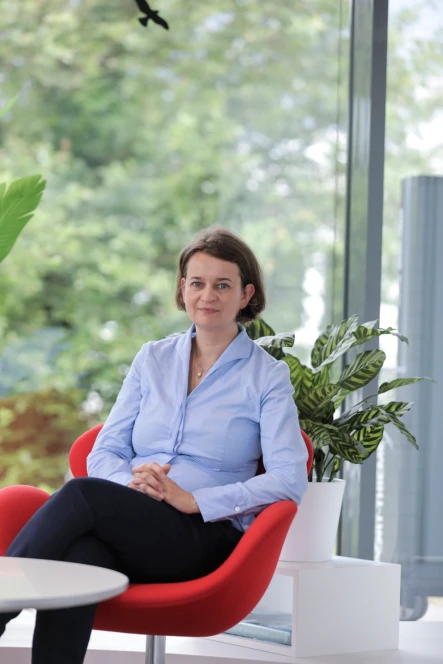
You are Germany’s first professor for heat pumps. Can you tell us a bit about your career to date?
Prof. Dr.-Ing. Constanze Bongs: I studied industrial engineering at TU Berlin, In my main course, I focused on energy and raw materials management and energy technology, including absorption refrigeration technology. I wrote my diploma thesis at the Commonwealth Scientific and Industrial Research Organization (CSIRO) in Australia. At that time, I already worked on the modeling and simulation of a thermally driven process for air conditioning.in buildings. I gained further experience abroad during two study semesters at the Luiss Guido Carli business school in Rome and during an internship in Vancouver.
You did your doctorate at the Fraunhofer Institute for Solar Energy Systems ISE in Freiburg. Did you already come into contact with building technology back then?
Prof. Bongs: Yes, for my doctoral thesis in the field of building technology at ISE, I developed and characterized novel sorptive coated heat exchangers that can dehumidify air using renewable energy such as solar heat. As a project manager and head of the building systems technology team, I was involved in numerous national and international projects in the field of energy-efficient and renewable building technology. During this time, I also focused my research on the use of heat pumps in existing buildings, especially multi-family homes.
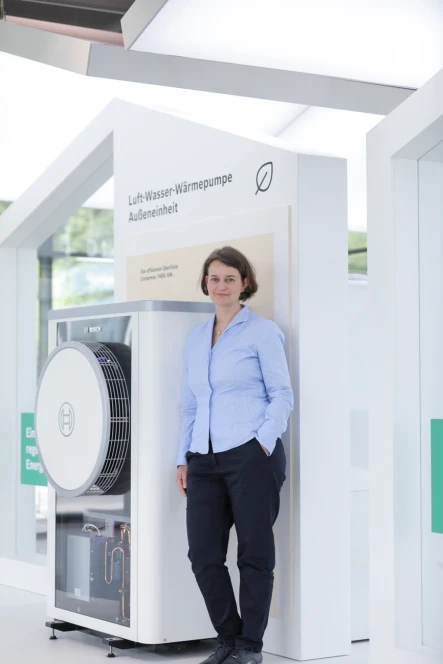
So it was a natural step for you to apply to Karlsruhe University of Applied Sciences to become Germany’s first professor for heat pumps?
Prof. Bongs: In a way yes. This new professorship aligns closely with my areas of interest. After my time at Fraunhofer ISE, I wanted to move into teaching and first got the opportunity to become a professor of heating technology at BHT (Berliner Hochschule für Technik) in the Building Services and Energy Technology program. When the new endowed professorship was established at HKA this spring, I saw a great opportunity for me to combine research and teaching with a clear focus on heat pump technology.
You just mentioned the term ‘endowed professorship’. What does that mean?
Prof. Bongs: The endowed professorship is financially supported by companies. With the Bosch Home Comfort Group, we have a strong partner at our side. This combination is interesting for several reasons. The connection to industry enables a very close practical relevance. The intensive exchange allows us to specifically address requirements faced by manufacturers in our research. Through direct discussions, we learn what topics interest the industry, and we can inspire each other. This interaction benefits both sides and makes an endowed professorship so attractive.definition of my endowed professorship. The rule of freedom of research and teaching also applies in my case. I rather see the advantages of the cooperation. For example, the question of which student profile would be interesting from point of view of the sponsors, so that our teaching can take their needs into account.
Let’s take a look into the future. What’s your vision for your endowed professorship?
Prof. Bongs: To achieve climate targets in the building sector, we need a paradigm shift, in particular in heat supply. Most buildings in Germany are existing buildings, often with outdated heating technology. My vision is to decarbonize these buildings and make them more climate-friendly overall. Heat pumps are one way of achieving this goal. Political guidelines will result in heat pumps also being increasingly used in existing buildings. In order to better understand the related challenges and develop solutions, we need appropriately trained engineers. The endowed professorship at Karlsruhe University of Applied Sciences aims to meet this need.
Heat pumps are still heavily underrepresented in larger existing buildings, and there is a need for further research and development of solution approaches, for instance, to replace decentralized supply solutions like gas-fired floor heating systems. There is also planning uncertainty regarding the implementation of more complex system solutions and the use of heat pumps in urban areas. This is where I want to start and think about renewable heat supply in close connection with the buildings.
What goals do you want to achieve with your professorship in, let’s say, five years?
Prof. Bongs: In terms of teaching, I hope we can inspire many young people to take an interest in this important future topic with our attractive and interesting offer. From the research perspective, we want our solutions to help significantly reduce carbon emissions in the building sector. Heat pumps – and especially the widespread use of this technology – will play a decisive role here.
The heat pump market has grown rapidly in recent years but then slumped sharply. Is this just a temporary dip?
Prof. Bongs: I am firmly convinced that the heat pump as a technology is here to stay and will continue to grow. The development in recent years needs to be put into perspective. Various external factors, including political ones, played a role. However, I believe the general growth trend in the heat pump sector will continue. It is important that people accept it and understand that fossil fuels must be replaced in to successfully counteract climate change.
Where will heat pumps be in 2030? How will this technology develop?
Prof. Bongs: Heat pumps are an essential pillar of our future heat supply, the fundamental technology in the decentralized heat supply of buildings. I also see great potential for decarbonizing heating networks. The use of heat pumps in industry and in district heating networks will also be an important topic by the end of this decade.
What advice would you give manufacturers to ensure their products are successful on the market in the long term?
Prof. Bongs: There are various aspects to consider here – there is no single recommendation. Manufacturers should convey a positive image of heat pumps and make it clear that this technology is the preferred solution for protecting the climate. This also includes a consistent decision in favor of natural refrigerants. Economic efficiency is also important. Many end customers are still afraid of exploding electricity costs; manufacturers should provide more information in this area. The same applies to concerns that heat pumps might not be sufficient to heat homes in winter.
Let’s talk about another aspect, the shortage of skilled labor in the industry. To what extent can your professorship contribute to improving the situation?
Prof. Bongs: After graduation, our students have a good education in thermodynamics and – if they specialized in refrigeration, air conditioning and environmental technology – also a comprehensive understanding and knowledge of refrigeration technology and refrigeration processes. As a university, you can only lay the foundations; everything else has to be obtained in practice, in everyday professional life. Our task is to convey a basic technical understanding and arouse interest in these topics. The young people are then of interest to industry or planning offices, for example as employees in the field of building technology. To convey our own enthusiasm for heating and cooling technology, a healthy mix of research and teaching is important for us at Karlsruhe University of Applied Sciences.
In how far can heating contractors benefit from this?
Prof. Bongs: It’s great if our students already completed vocational training in a relevant profession and then get a degree. This is certainly the ideal case and these students often come from families with a corresponding tradition and plan to take over the family business. Our other graduates are more likely to pursue a career in planning or development. Larger heating companies that carry out complex projects, for example, in the industrial or public sector, usually have their own planning department. This can be a good starting point for them.
Prof. Dr. Bongs, thank you for the interview.